

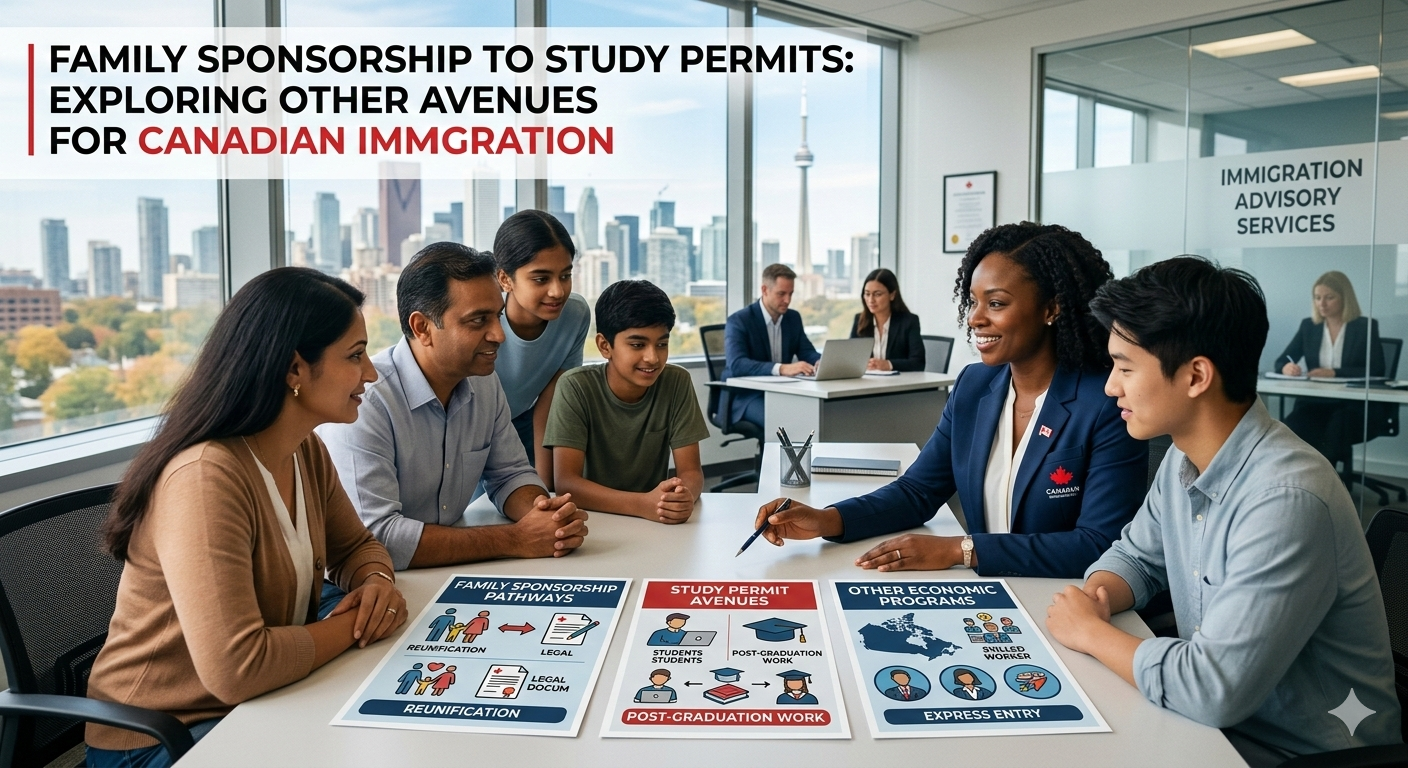
There’s More Than One Way In
When people think of moving to Canada, the first word that usually comes up is Express Entry. And fair enough. It’s one of the most popular routes.
But here’s the truth: Express Entry isn’t the only way in. Not even close.
If you’ve ever felt stuck because your CRS score wasn’t high enough, or you didn’t qualify for a provincial stream, you’re not out of options. In fact, there are many legitimate and strategic ways to make Canada home. Whether it’s through family, education, work, or specialized programs, there’s likely a pathway that fits your life.
Let’s explore them.
Reuniting Families: Why Canada Makes Space for Loved Ones
Canada believes in keeping families together and its immigration system reflects that. If you have close family in Canada, or if you are that family member already living there, the Family Sponsorship Program might be your golden ticket.
Here’s what that can look like:
- Spouse or Partner Sponsorship:
If you’re married to or in a committed relationship with a Canadian citizen or permanent resident, they can sponsor you. This applies whether you’re already in Canada or living abroad. - Dependent Children Sponsorship:
If your child is under 22 (or older but unable to support themselves due to a condition), you can sponsor them too. - Parents and Grandparents Program (PGP):
This one’s competitive. It runs on a lottery system and comes with income requirements. But it’s one of the few programs that lets parents and grandparents move permanently. - Other Relatives:
Rare, but possible. In special situations (like when someone has no other family in Canada), they may be able to sponsor a relative such as a niece, nephew, or orphaned sibling.
Keyword integration: Canadian family sponsorship, spouse sponsorship Canada, parent and grandparent program, dependent children immigration, family reunification Canada
The Study Route: More Than Just a Degree
Let’s talk about the student pathway. One of the most flexible and powerful routes into Canada.
Yes, it starts with education. But the opportunities that follow can change your entire future.
- Start With a Study Permit:
To get one, you need to be accepted into a Designated Learning Institution (DLI) and show proof of financial support. Once you’re in, you’re on your way. - Then Comes the Post-Graduation Work Permit (PGWP):
This open work permit allows you to stay and work in Canada after your studies usually for the same length of your program. It’s your chance to gain that all-important “Canadian work experience.” - The PR Transition:
Many international students use the PGWP as a bridge to PR through Express Entry (via the Canadian Experience Class), PNPs that favour grads, or other pathways that reward local experience.
This route is popular for a reason. It’s education + integration in one.
Keyword integration: Canadian study permit, immigrate to Canada through education, Post-Graduation Work Permit, PGWP Canada, study in Canada and PR
Work Permits: When Gaining Experience Opens New Doors
Want to move to Canada through work? There’s more than one kind of permit and many of them can lead to PR if played right.
Here are a few options:
- Employer-Specific Work Permits:
These are tied to a job offer and often require an LMIA (Labour Market Impact Assessment). The employer must prove they couldn’t find a Canadian for the job. - Open Work Permits:
These are more flexible. You’re not tied to a specific employer. You might qualify if your spouse is studying or working in Canada, if you’ve graduated from a DLI, or if you’re participating in a youth exchange program like IEC. - Temporary Foreign Worker Program (TFWP):
This covers most LMIA-based jobs, especially in in-demand sectors. - International Mobility Program (IMP):
These are LMIA-exempt and usually based on trade agreements, reciprocal benefits, or public interest. (Think NAFTA/USMCA, GATS, or intra-company transfers.)
No matter which permit you start with, if you’re gaining Canadian experience, you’re building a stronger case for PR.
Keyword integration: Canadian work permit, open work permit Canada, LMIA Canada, Temporary Foreign Worker Program, International Mobility Program, Canadian work experience for PR
Other Unique Pathways You Might Not Know About
Sometimes, the best route is the one that flies under the radar. These lesser-known programs are worth considering:
- Caregiver Programs:
If you’re providing care for children, seniors, or people with high medical needs, there are dedicated programs that can lead to PR. - Rural and Northern Immigration Pilot (RNIP):
Designed to help smaller communities attract and retain newcomers. Think less Toronto, more Thunder Bay but with amazing support and faster processing. - Atlantic Immigration Program (AIP):
A great option if you’re open to living in Newfoundland, Nova Scotia, New Brunswick, or PEI. Employers play a key role here, and the pathway is built for long-term retention. - Refugee and Asylum Routes:
For those seeking protection due to danger or persecution in their home country. A very specific pathway, but still part of Canada’s immigration fabric.
Keyword integration: caregiver program Canada, RNIP Canada, Atlantic Immigration Program, Canadian refugee claim, immigration to rural Canada
Final Word: Your Path Is Yours
Canada isn’t a one-size-fits-all kind of country and neither is its immigration system.
You might come in through study and stay for work. Or maybe your family ties are your strongest link. Perhaps a smaller town needs your skill set, or a job offer shifts everything.
Whatever the path looks like, one thing is true: it’s yours to walk. With the right guidance and clarity, you can take the route that fits your goals, not just the most popular one.
Ready to explore your options and build your path to Canada the smart way?
Book a free 1-on-1 consultation with Cole.
Get personalized guidance, a clear step-by-step strategy, and expert support every step of the way.
Click here to book your session and take the first step.
Your new life in Canada isn’t just possible. It starts with the right move.